
WHAT ARE YOU LOOKING FOR?
Popular Tags
Select your language
Speech
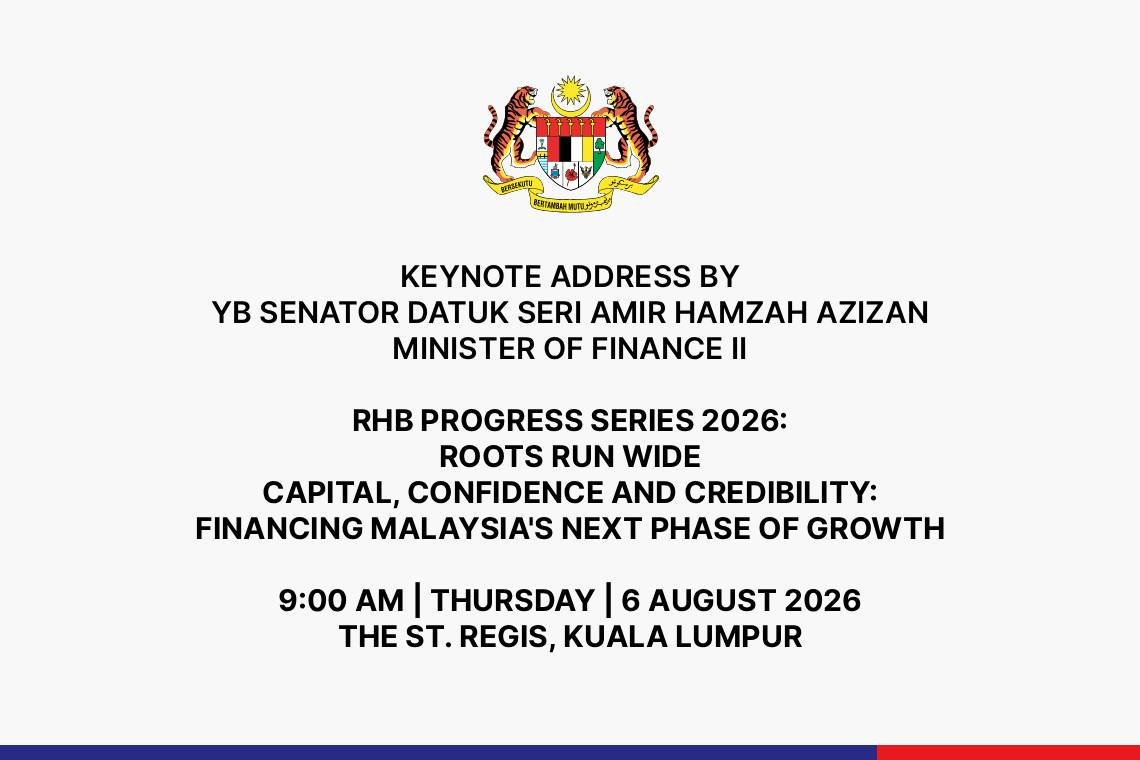
RHB Progress Series 2026
Speech
Bismillahirrahmanirrahim
Yang Berbahagia Tan Sri Ahmad Badri Mohd Zahir,
Group Chairman, RHB Banking Group
Yang Berbahagia Tan Sri Ong Leong Huat,
Board of Director, RHB Banking Group
Yang Berbahagia Dato' Mohd Rashid bin Mohamad,
Group Managing Director and Group Chief Executive Officer,
RHB Banking Group
Distinguished guests
Ladies and gentlemen
Assalamualaikum Warahmatullahi Wabarakatuh and Salam Malaysia MADANI
- More than half a century ago, a stretch of land on the southern tip of Penang Island was still growing rice. Bayan Lepas was part of Penang’s rice bowl. Penang was navigating a difficult economic transition, jobs were limited and many young people were looking elsewhere for work. In 1971, few would have imagined that these fields would one day sit at the heart of a semiconductor ecosystem moving into design and other higher-value activities.
- In 1972, that padi field became Malaysia’s first free trade zone. Intel opened its first offshore assembly plant there, starting with about US$1.6 million and 100 employees. It was a factory on farmland, and a bet that if Malaysia created the right conditions, more could grow around it.
- RHB has given us the theme Roots Run Wide. Bayan Lepas reminds us that economic roots are built over generations, as one generation leaves the next with a stronger starting point. Think of that journey through one family.
- The great-grandfather planted padi. He worked hard every year, but whether that work paid depended on rain and on a rice price set far beyond Penang.
- His daughter entered one of the new factories and brought home a regular wage. That changed what the family could plan for, save and spend on the next generation.
- Her son studied engineering, entering an industry where Malaysians were increasingly maintaining the equipment, improving the processes and running the plants.
- And the fourth generation enters an economy where opportunities are gradually opening up in chip design and other higher-value work.
- Four generations on one stretch of coast. Each generation had more choices than the one before, because Bayan Lepas itself had become more capable, with experienced engineers, stronger suppliers and better infrastructure.
- Incentives can help win the first investment. The capability already built around it is what brings the expansion, the next project and the investor back again.
- When people ask what Malaysia’s next phase of growth needs, Bayan Lepas gives us a useful answer. Over time, each new investment added skills, suppliers and infrastructure that made the next step easier.
- To create that same cumulative effect elsewhere, we need institutions investors can rely on through several cycles, capital that can take different kinds of risk, and companies and workers able to build on what came before. That is where capital, confidence and credibility come together.
Ladies and gentlemen,
- Credibility comes first because a company putting a long-term asset in Malaysia is making assumptions about our public finances, our rules, our institutions and how the country responds when the world changes.
- Investors therefore need to see a record behind those assumptions. Our fiscal deficit has come down from 6.4% of GDP in 2021 to 3.7% last year. Behind that improvement, we have strengthened the fiscal framework through the Public Finance and Fiscal Responsibility Act, retargeted fuel subsidies and continued modernising tax administration through e-invoicing.
- That path has been tested this year by an energy shock that raised the cost of protecting households and businesses. We have been open about that cost and responded by providing support where it was needed while keeping the broader fiscal direction intact, including our commitment to bring the deficit below 3% over the medium term.
- Last month, we took that credibility to the market and let it be priced. We issued US$1.5 billion in global sukuk, with demand from more than 140 international investors leaving the issuance 4.7 times oversubscribed. Both tranches achieved the tightest spreads Malaysia has ever recorded, 15 basis points over US Treasuries on the 5.75-year tranche and 25 basis points on the ten-year.
- The effect extends beyond the Government’s own borrowing. Because the sovereign curve is an important reference for Malaysian issuers borrowing internationally, fiscal discipline reaches beyond Putrajaya and into the cost of capital for Malaysian companies borrowing in international markets.
- Capital is already backing that confidence. Approved investments reached a record RM431.1 billion last year, with domestic investors providing RM219.6 billion, slightly more than half.
- I would hold on to that number because foreign investors notice whether Malaysians are willing to invest in Malaysia too. Through GEAR-uP, the six major GLICs have committed an additional RM120 billion of domestic direct investment over five years.
- That same domestic conviction is reflected in our capital market, which has reached RM4.3 trillion. The Capital Market Masterplan sees it reaching RM5.8 trillion to RM6.3 trillion by 2030. Reaching that scale requires more companies worth listing, investors willing to back firms earlier, and financing that keeps pace with new business models.
- The government can provide certainty, but the market has to take risk. Government should make the foundations predictable, while investors should make the possibilities exciting by backing new companies, technologies and business models before the outcome is obvious.
- That risk changes as a company grows. At the beginning, the uncertainty is around whether an idea will work at all. Later, it is about whether the company can scale, enter new markets and turn that growth into durable cash flows.
- The capital therefore changes along the journey. Venture capital can take the earliest risk, growth capital and private equity can fund scale, banks become more important as cash flows strengthen, and public markets provide another source of capital as companies mature.
- Malaysia already has many of those pools of capital. Khazanah’s Jelawang Capital and KWAP’s Dana Perintis are bringing more institutional capital into the earlier stages, while our banks and capital market are much deeper further along the journey. The strength of that financing spectrum is in the connections between them, so that a company that proves itself at one stage can find the capital to move on naturally into the next.
Ladies and gentlemen,
- The opportunities for that capital are spreading across the country. Bayan Lepas and Kulim are moving further into design, advanced packaging and semiconductor equipment. Johor combines manufacturing, logistics, digital infrastructure and proximity to Singapore, and drew RM110 billion of approved investment last year, more than any other state.
- The Johor-Singapore Special Economic Zone can offer investors a larger operating platform, with functions placed where they make the most economic sense. Sarawak brings reliable energy, industrial land and long investment horizons. Malaysia becomes stronger when these places do different things well within the same national system. Roots run wide when more regions develop their own reasons for capital to stay, expand and return.
- The Bayan Lepas story also tells us what to watch after an investment is approved. We have to follow the job, then the wage, then the skill, and ask whether each improves over time.
- The wage story is helped by relatively contained inflation. Inflation stood at 1.9% in June after averaging 1.4% last year, which means gains in pay are more likely to translate into gains in purchasing power, even as subsidy reform continues.
- On wages, we asked the government-linked system to move first. The six major GLICs have already implemented living-wage policies for their permanent Malaysian employees, and that commitment has since broadened across 34 GLICs and GLCs, covering 153,000 workers at a minimum of RM3,100 a month.
- What matters is whether that improvement spreads beyond the government-linked system. The wider test is whether rising productivity shows up in better pay and stronger skills, whether MSMEs gain new customers and capabilities from investments around them, and whether young Malaysians can see serious careers being built here.
Ladies and gentlemen,
- Government cannot build that outcome alone because most of the capital, innovation and expansion will ultimately have to come from the private sector. Our role is to keep the foundations credible, use public capital where it can unlock a market, and make it easier for private capital to carry the larger share. The global sukuk gave us a useful benchmark.
- International investors showed strong conviction in Malaysian sovereign risk. The question for the banks, asset owners and fund managers in this room is whether our own financial system has the expertise and instruments to back good Malaysian companies earlier in their journey.
- The standard remains high. The difference is being able to price that risk earlier, rather than waiting for uncertainty to disappear.
Ladies and gentlemen,
- Let me take you back one last time to Bayan Lepas in 1971. The people in those padi fields could not see the semiconductor cluster ahead. They could see that jobs were scarce, young people were leaving, and Penang needed another path.
- The decision taken in 1972 opened that path, and generation after generation added capability to it. A factory became an ecosystem, and a workforce became a national capability.
- Each wave of foreign investment left behind more Malaysian suppliers, engineers and companies, strengthening the case for the next wave.
- Fifty years later, our starting point is higher and our responsibility larger. The ambition now is an economy with deeper capabilities, where more of the highest-value work is created and carried out here.
- It is also an economy where Malaysian companies turn capability into scale, scale into regional reach, and each generation begins from a stronger base than the one before.
- That is ultimately how this generation will be remembered. When someone looks back at this decade fifty years from now, I hope they can say that we used this period of strong investment to deepen Malaysian capability, widen opportunity across the country and give the next generation a stronger starting point.
- That is the standard I would use for the next phase of growth. For Malaysia, the lasting return on capital coming into the country is the additional capability it leaves behind.
- The fifth generation in our Bayan Lepas family may work in an industry none of us in this room can yet name. We may not know what she will build, and we do not have to.
- Our responsibility is to give her generation the same sense of possibility that Bayan Lepas opened for the first generation, from a much stronger starting point.
- Our success is not what we build for the next generation, but what we make possible for them to build.
Wabillahi Taufik Wal Hidayah, Wassalamualaikum Warahmatullahi
Wabarakatuh.
Thank you.